
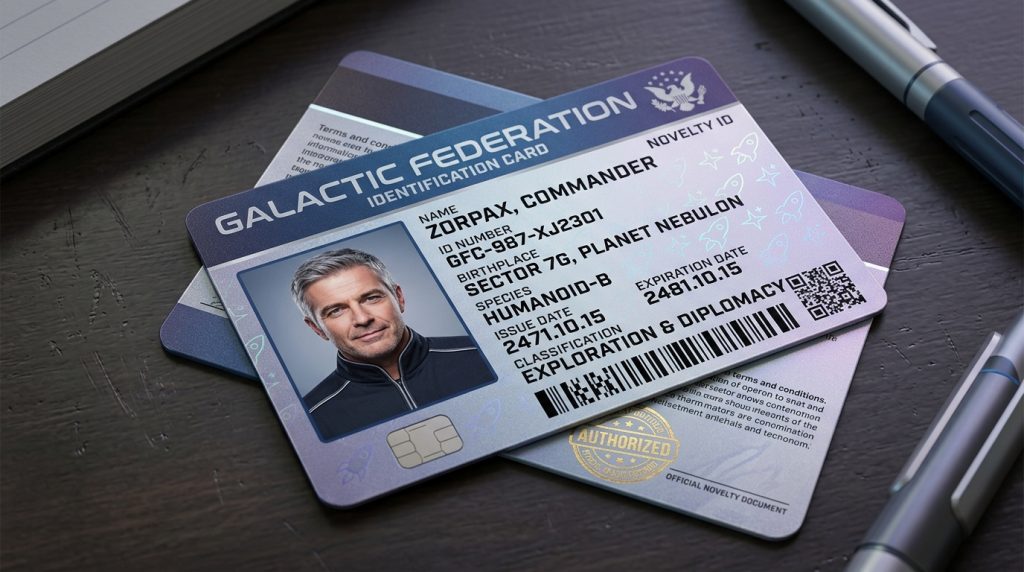
In an increasingly digitized world, the tangibility of physical documentation remains a cornerstone of personal security and identity verification. Whether for theatrical productions, security testing, or collectors of high-end memorabilia, the demand for high-quality novelty id products has grown significantly. However, as government agencies implement more sophisticated security measures like Real ID and biometric integration, the craftsmanship required to produce a convincing replica has reached an industrial-grade level of complexity.
The Technical Anatomy of a Professional Replica
When evaluating the quality of a novelty id, the first thing a professional looks at is the material composition. Standard PVC cards are no longer the industry benchmark. Today, premium providers utilize Polycarbonate (PC) layers. This is critical because polycarbonate cards have a distinct “metallic” ring when dropped on a hard surface—a detail that security professionals often use as a tactile verification method.
Furthermore, the integration of multi-spectral security features is what separates a low-tier product from a high-fidelity novelty id. These features include:
- Optically Variable Ink (OVI): Ink that shifts color depending on the angle of the light, shifting from gold to green or copper to red.
- Micro-printing: Text so small it appears as a solid line to the naked eye but is perfectly legible under a jeweler’s loupe.
- Laser Engraving: Unlike standard inkjet printing, laser engraving burns the data into the middle layer of the card, creating a raised surface that can be felt by a human thumb.
Why Digital Precision Matters
A common pitfall for many in the industry is the failure to properly encode the digital components of a novelty id. A document can look visually perfect, but if the PDF417 2D barcode or the magnetic stripe does not contain correctly formatted data, the document fails its primary purpose. Professional-grade novelty id makers use proprietary software to ensure that the data string matches the visual information on the front of the card, including correctly calculated check-digits and ISO-compliant formatting.
This level of precision is why the market has shifted toward specialized providers. The “human touch” in this industry isn’t just about the printing; it’s about the graphic designer who manually adjusts the “ghost image” transparency to ensure it doesn’t obscure the background security patterns.
The Collector’s Perspective: Authenticity and Detail
For many enthusiasts, owning a novelty id is about appreciating the art of document security. Collectors often look for replicas of historical documents or international IDs that are no longer in circulation. In these cases, the accuracy of the holographic overlays becomes the most important factor. High-end novelty id production involves creating custom kinegrams—holograms that show movement and depth—which are nearly impossible to replicate without expensive industrial machinery.
The tactile experience is also vital. A professional novelty id should have a “sand-flick” texture or a specific lamination feel that mirrors the official document it is based on. If the edges of the card are sharp or show signs of “fringe” from a poor cut, it immediately loses its value as a high-quality replica.
Navigating the Modern Market
As search engines become more sophisticated at identifying high-quality content, it is important to understand the legitimate applications for these products. Movie production houses, private investigators testing security vulnerabilities, and stage performers all rely on the availability of a realistic novelty id to maintain the “suspension of disbelief” or to conduct thorough audits.
When looking for a provider, the “red flags” are usually found in the details. Does the provider understand the difference between a “flat” print and a “UV” reactive print? Do they offer 1:1 replicas of the state-specific perforated images that only appear when held up to a light source? These are the questions that define a professional service.
Conclusion: The Future of Document Replication
The gap between amateur production and professional craftsmanship continues to widen. As security features evolve, so too does the technology used to create a high-fidelity novelty id. For those who require these items for professional use or collection, the focus must always remain on technical accuracy, material quality, and the digital integrity of the encoded data. By prioritizing these elements, users ensure they are receiving a product that isn’t just a piece of plastic, but a masterclass in modern security printing.
