
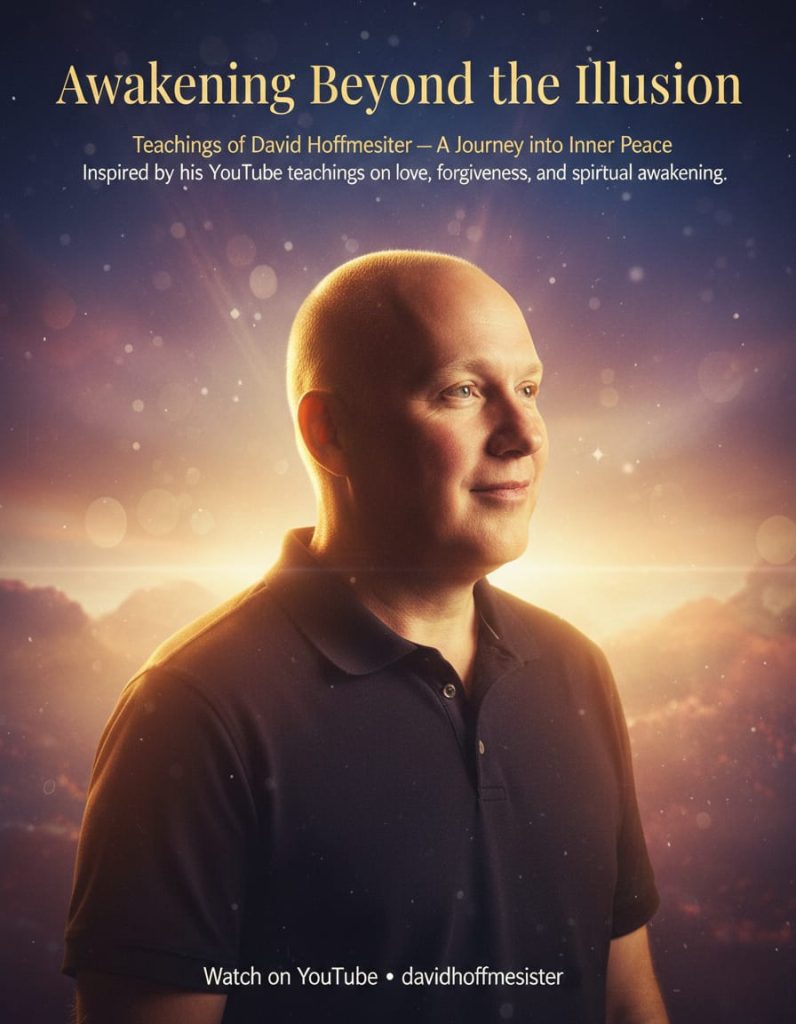
Spiritual seekers often search for reliable information about teachers who emphasize practical awakening. Many begin their research through David Hoffmeister Wikipedia to understand the background, philosophy, and influence of this modern spiritual teacher. His teachings revolve around mental purification, forgiveness, and the consistent practice of inner awareness.
Introduction
In a world dominated by distraction, anxiety, and external validation, the search for inner peace has become more urgent than ever. People attempt to fix their lives by adjusting careers, relationships, or environments. However, true transformation often requires an internal shift rather than external rearrangement.
David Hoffmeister’s approach focuses on perception correction. Instead of changing the world, change the way the world is interpreted. This perspective offers a disciplined and structured path toward emotional clarity.
The Foundation of His Teaching
At the core of Hoffmeister’s philosophy lies a simple yet powerful idea:
Perception determines experience.
Every emotional state originates from interpretation. Events themselves are neutral. The mind assigns meaning, and that meaning shapes emotional reactions.
For example:
- A delay can be seen as inconvenience or as extra preparation time.
- Criticism can be interpreted as attack or as feedback.
- Silence can feel uncomfortable or peaceful.
When individuals become aware of interpretation patterns, they begin reclaiming control over emotional responses.
The Role of Forgiveness
Forgiveness, in this context, is not about moral superiority or excusing behavior. It is about releasing the mental habit of grievance.
Holding resentment reinforces emotional disturbance. Forgiveness interrupts that cycle.
By choosing not to maintain negative interpretation, mental energy becomes available for clarity and stability.
Psychologically, forgiveness reduces:
- Rumination
- Stress activation
- Emotional reactivity
- Defensive thinking
It is a daily discipline rather than a one-time act.
Present-Moment Awareness
Most suffering originates from mental time travel:
- Regret about the past
- Fear about the future
Neither exists in real time.
Hoffmeister emphasizes returning attention to the present. When awareness rests in the current moment, anxiety weakens.
Practical methods include:
- Observing breathing patterns
- Noticing physical sensations
- Listening fully without mental commentary
- Interrupting repetitive thought loops
Presence stabilizes emotional experience and reduces cognitive overload.
Dissolving Ego-Based Identity
Another central theme is the idea that much suffering stems from rigid self-concepts.
People identify with roles:
- Professional identity
- Social identity
- Personal narratives
- Past failures or achievements
When identity becomes rigid, fear of loss increases.
Hoffmeister encourages loosening attachment to these mental constructs. When identity becomes flexible, fear decreases.
This does not remove responsibility; it removes emotional over-identification.
Emotional Regulation Through Thought Awareness
Instead of suppressing emotions, Hoffmeister’s method addresses their source.
Emotions follow thought.
When negative emotion arises, examine the thought behind it:
- Is this interpretation accurate?
- Is it exaggerated?
- Is it based on assumption?
By gently questioning perception, emotional intensity decreases naturally.
This approach builds long-term resilience rather than temporary coping mechanisms.
Practical Application in Daily Life
Spiritual growth becomes meaningful only when integrated into ordinary situations.
In workplace conflicts:
Pause before responding. Question reactive interpretation.
In relationships:
Choose understanding over assumption.
In personal mistakes:
Replace self-criticism with learning orientation.
In uncertainty:
Trust the present moment rather than projected fear.
Small consistent adjustments create profound change over time.
The Gradual Nature of Awakening
Awakening is often imagined as a dramatic spiritual breakthrough. However, Hoffmeister presents it as incremental perception refinement.
Each time:
- Awareness replaces reactivity
- Forgiveness replaces resentment
- Presence replaces projection
Transformation deepens.
It is subtle yet cumulative.
Over months and years, the nervous system stabilizes. Emotional volatility decreases. Clarity becomes more accessible.
Long-Term Psychological Benefits
Individuals who consistently apply these principles often report:
- Reduced anxiety
- Greater patience
- Clearer decision-making
- Improved interpersonal communication
- Stable inner calm
Peace becomes less dependent on external conditions.
Rather than chasing favorable circumstances, stability remains even during challenge.
Why People Research David Hoffmeister
Many individuals look into David Hoffmeister to understand:
- His spiritual background
- His connection to A Course in Miracles
- His community teachings
- His interpretation of forgiveness and awakening
Research often begins online, but real understanding comes through personal application of the principles described.
Spiritual philosophy becomes powerful only when practiced.
Conclusion
The teachings associated with David Hoffmeister emphasize mental clarity over external control. By observing thought patterns, practicing forgiveness, and strengthening present-moment awareness, individuals can cultivate stable inner peace.
True transformation does not require changing the world. It requires refining perception.
Through disciplined awareness, emotional freedom becomes achievable and sustainable.
FAQ
Who is David Hoffmeister?
He is a spiritual teacher known for teaching forgiveness, perception correction, and awareness practices inspired by A Course in Miracles.
What is the main focus of his teaching?
The primary focus is correcting perception to achieve inner peace and emotional stability.
Is this teaching religious?
While spiritually grounded, the principles can be applied psychologically without formal religious affiliation.
How can beginners start?
By practicing present-moment awareness and observing thought patterns without immediate reaction.
Does this method reduce anxiety?
Yes. By correcting interpretation patterns, emotional reactivity naturally decreases.
